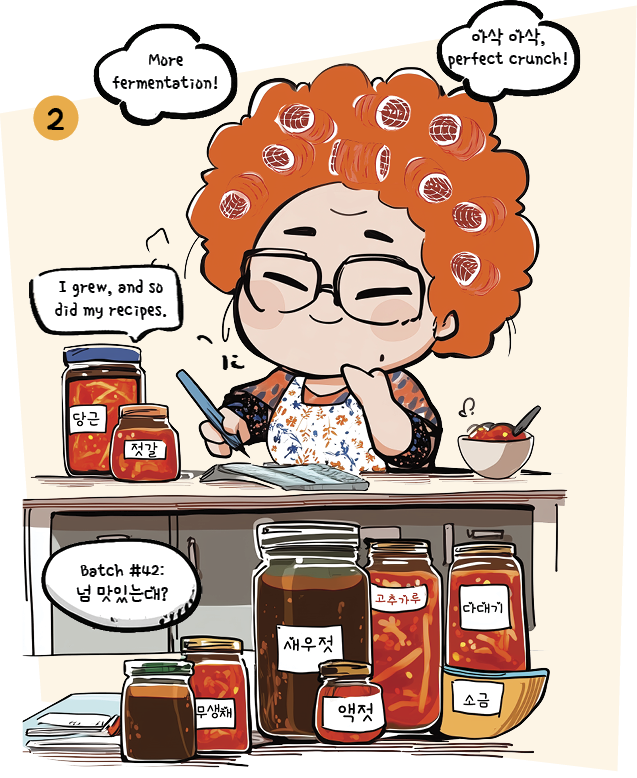
Long before there was a destination, Kimchi Mama had already made a decision — even if she never named it.
She cooked for everyone.
Not selectively. Not strategically. Not with an audience in mind. In Jeju, cooking for everyone was not generosity as an idea. It was practicality as a value. People came with different needs, different bodies, different days behind them. Food had to meet them where they were, not ask them to adapt.
This instinct formed early and never left.
In Jeju, Kimchi Mama saw how easily food could exclude without meaning to. Strong flavours that overwhelmed some. Ingredients that quietly left others out. Assumptions baked into recipes that only worked for a narrow group. She learned quickly that care required awareness — and that awareness required intention.
“If someone cannot eat comfortably at your table, the table is too small,” Kimchi Mama says. “So you make it bigger.”
Cooking for everyone did not mean flattening flavour. It meant choosing balance. It meant depth without aggression, warmth without heaviness, and familiarity without boredom. Her food learned to hold people gently rather than test them.
This philosophy wasn’t announced. It was practiced.
When people gathered, Kimchi Mama didn’t ask who belonged. She adjusted quietly. Portions shifted. Ingredients changed. Broths softened. Kimchi fermented with patience rather than sharpness. The food adapted without making anyone feel like an exception.
That adaptability became one of her greatest strengths.
It’s also why Kimchi Mama today feels so natural to so many different people. The food does not demand explanation. It does not require acclimatisation. It welcomes first, then nourishes.
🌶️ A Table Without Conditions
Kimchi Mama’s instinct to cook for everyone wasn’t developed later — it was always there. This belief runs through Kimchi Mama’s story, where inclusion is shown not as a feature, but as a foundation.
Over the years, this way of cooking shaped how people related to her food. They trusted it. They recommended it without hesitation. They brought others to the table without needing to check first.
That trust mattered more to Kimchi Mama than praise.
Cooking for everyone also meant learning restraint in a different way. She resisted the temptation to cook only for the loudest voices or the most enthusiastic eaters. She paid attention to the quiet ones. The ones who ate slowly. The ones who returned often but spoke little.
“The quiet people tell you the truth about your food,” she says. “They come back if it’s right.”
This sensitivity sharpened her judgment. Her dishes became more universally grounding without losing character. Her kimchi developed a depth that lingered without insisting. Her stews comforted without exhausting. The food carried memory, but it did not trap people in it.
This approach explains why her cooking translates so naturally across places. When food is built on care rather than assumption, it travels well.
Today, that same philosophy is visible throughout Kimchi Mama’s menu and reflected clearly in the dishes presented in the Kimchi Mama Menu PDF. The food is designed to welcome first, nourish second, and impress only as a by-product of doing things properly.
This is also why Kimchi Mama’s commitment to halal certification feels natural rather than performative. Cooking for everyone was never a late decision. It was the only way she knew how to cook.
🌿 Long Before the Journey Began
By the time Singapore entered the story, Kimchi Mama had already spent years widening her table. She did not need to learn inclusion later. She simply carried it forward.
She cooked for everyone long before the world was watching.
She cooked for everyone before there was a name for it.
She cooked for everyone because care, once learned, does not narrow.
If you’d like to experience what it feels like to sit at a table built without conditions, Kimchi Mama welcomes you warmly at her Singapore location — where the same openness that shaped her Jeju kitchens now lives on, plate by plate.
As Kimchi Mama herself says:
“Food should never ask who you are before it feeds you.”
And with that belief firmly in place, the story moves closer to its next turning point.