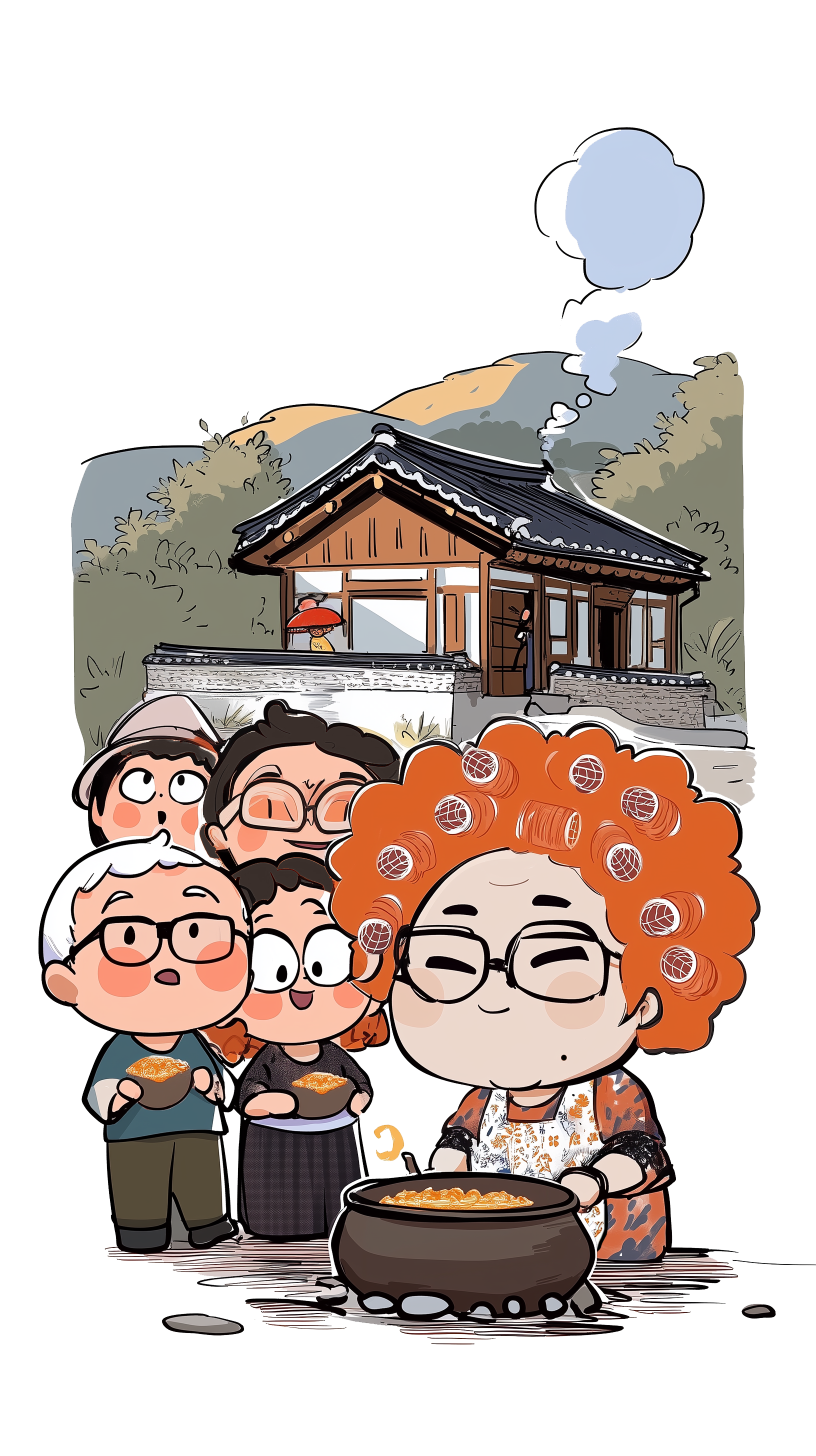
At first, it was only family.
Meals planned around familiar faces. Portions measured by habit. Flavours adjusted instinctively, because Kimchi Mama already knew who liked things softer, who preferred deeper broth, who needed warmth more than spice. Cooking for family meant cooking with certainty. There was trust built in long before the food reached the table.
But in Jeju, doors rarely stay closed for long.
A neighbour would arrive with a small request. Someone would stay for dinner because the weather had turned. A cousin would bring a friend. A friend would bring another. The table grew, quietly, without ceremony. And Kimchi Mama adjusted without comment — adding water to broth, lifting another jar of kimchi, slicing more vegetables, extending the meal rather than protecting it.
“If food runs out, it means you planned too tightly,” Kimchi Mama says. “So I learned to plan with space.”
This was the moment cooking changed its meaning.
Cooking for family is intimate. Cooking for a community requires awareness. Kimchi Mama began thinking beyond individual preferences and toward shared balance. Flavours had to be welcoming, not polarising. Portions had to feel generous without being excessive. Meals had to comfort many kinds of people at once.
She learned that community food must be steady above all else.
There was no room for unpredictability. When people gather, they are not looking to be challenged — they are looking to be held. Kimchi Mama’s cooking shifted accordingly. Her food became more consistent, more grounding, more quietly reliable. This wasn’t dilution. It was refinement.
The pot became a meeting place.
People talked while eating. Sometimes they didn’t talk at all. Both were welcome. Kimchi Mama noticed how food could ease conversation or allow silence without discomfort. She noticed how certain dishes slowed people down, how warmth softened moods, how familiarity encouraged people to return.
This is when she truly understood that food does more than feed bodies — it shapes atmosphere.
That understanding still defines Kimchi Mama today. Her food doesn’t compete for attention. It supports the room. It creates space for people to be themselves without performance.
🌶️ A Table That Widens Naturally
Kimchi Mama never set out to build a community. It happened because her food made people feel safe staying longer. This transition — from private cooking to shared table — lives at the heart of Kimchi Mama’s story, where care is shown to expand naturally when it’s consistent.
As the circle widened, Kimchi Mama learned new forms of discipline. Cooking for many meant planning ahead without rigidity. It meant preparing for absence as much as presence. Some days the table was full. Some days it was quiet. The food had to be right either way.
She learned not to attach her sense of worth to turnout. She cooked with the same care whether there were three people or ten. This steadiness protected her from disappointment and preserved the integrity of the food.
“If you only cook well when people are watching, you are not cooking,” she says. “You are performing.”
Community cooking also taught her fairness. Portions needed to be even. Flavours needed to be inclusive. Ingredients needed to respect everyone at the table. This instinct — to widen rather than narrow — would later shape her insistence on halal certification and her belief that food should never exclude quietly.
Today, that philosophy is visible throughout Kimchi Mama’s menu and reflected clearly in the dishes presented in the Kimchi Mama Menu PDF. The food is designed to be shared, returned to, trusted — not consumed once and forgotten.
Cooking for a community also strengthened Kimchi Mama in unexpected ways. She became more observant, less reactive. She learned to read rooms the way she once read pots. She learned when to adjust quietly and when to let things be.
Her confidence stopped depending on approval. It rested in preparation.
🌿 From One Table to Many
By the end of this chapter, Kimchi Mama’s kitchen no longer belonged only to her family. It belonged to a growing circle of people who trusted her food without needing explanation.
She didn’t announce the change. She didn’t name it. She simply kept cooking — steadily, generously, and without drawing lines around who was welcome.
That instinct still guides her today.
If you’d like to experience what happens when family cooking grows into community cooking, Kimchi Mama welcomes you warmly at her Singapore location — where every table carries the same openness first learned in a Jeju home kitchen.
As Kimchi Mama herself says:
“A good table doesn’t feel full. It feels open.”
And the story moves forward.